Wednesday, July 16, 2014

Italian Food by Region

Italy is a country steeped in rich culinary traditions that span generations of home cooks. But it's key to understanding "how to cook Italian food" that cuisines vary drastically by region. The typical dishes local to each geographic area are often driven by the ingredients available, and shaped by the region's history. (Remember that for centuries the Italian peninsula was broken up into many city states, and only became unified in recent history.) Italian cooking traditions are strong, with loyalty to certain dishes and recipes almost or equally as powerful as soccer loyalties. Here are a few of the Italian regions I've been to, and the food that I ate:

1) Tuscany: Meat, Meat, and more Meat
This is the part of Italy nearest and dearest to my heart, since my partner is from Florence, and his family from the Chianti region of the Tuscan countryside (such a terrible place to go visit my in laws, I know.) Tuscan food is a tradition from years of necessity, many typical Tuscan dishes descending from peasant's food that utilized what was available, rather than elegant. For example pappa pomodoro, tomato bread soup, and ribollita, came from peasants repurposing stale old bread, adding what leftover vegetables they had around, and creating soups from them. This food is hardly pretentious, but it is delicious. Here are some dishes I had in Tuscany on my most recent visit.

Let's start with Tuscan meat. Traditional peasants' dishes lampredotto and tripa (yes, that's tripe) use the animal innards, stewed in savory broth, until palatable. (Well that's still debatable, but it's classic street food there.)

 Butchery at the Firenze Mercato Centrale (central market), which has been recently renovated:


We took a day trip to the Tuscan countryside and stopped to have lunch in Greve, the sister city to Rehoboth Beach, Delaware, where my family has a beach house (see post on Rehoboth dining). There is a famous macelleria (butcher) there:


Among the meats we tried was the soppressata, a type of salami:

But the best was the steak tartare:


I used to be a vegetarian, but that raw meat was drool-worthy.

Tuscan food is very simple, with minimal seasoning and quality ingredients. In addition to the variety of interesting meat that Tuscan cuisine has to offer, are the incredible pastries:


Breakfast of champions, in my opinion.

2) Umbria: Truffle Country
The region of Umbria, landlocked in the interior of the continent between Tuscany the Marche, has the perfect climate for growing truffles. We stopped at a hilltop village in Umbria and sampled some local cheeses crusted with earthy truffles:


Cheese selection with jam and honey: lunch for two.

3) Marche: Seafood Fare
The region of Marche, on the coast of the Adriatic (directly opposite Tuscany) is most famous for seafood in its cuisine.  Fresh fish, prawns, you name it, Le Marche is all about the frutti di mare:


We had dinner at a tiny hole-in-the-wall trattoria that served only the day's catch:


Pasta typical of the region, with mussels and clams.


Fresh fish, grilled with lemon.

And of course, like all parts of Italy that I've been to, Le Marche had delicious gelato!

Adorable gelateria in Urbino.

Another region of Italy famous for seafood is of course Veneto. But one of the things that struck me the most about Venice, aside from the delicious pasta, were the markets filled with fresh produce:


Whether in Lazio (where Rome is), or Campania (on the Bay of Naples), fresh, local fruits and vegetables were to be found everywhere!


Sunday, June 8, 2014

Anniversary Dinner

For my parents' 35th wedding anniversary my sisters and I threw them a dinner party to pamper them in style. Here's what we did:

First we Pinterested the sh*t out of their backyard. My sister made the menu cards, complete with his and hers cocktails.


 (For the record, those flowers were from Costco - great deal, and so gorgeous!)


For the first course: seared scallops over salad with grapefruit, avocado and a citrus vinaigrette:


The main course: grilled mahi mahi over a jicama slaw with chipotle crema:


The dessert was rum cake, a tribute to my parents' wedding cake. I didn't take any photos of the cake because I was too busy eating it.

Monday, May 26, 2014

Commonwealth in Cville

Commonwealth in Charlottesville, Virginia may be known for its Skybar, but the restaurant is really top notch as well. We ordered off a pre fixe menu for graduation weekend diners and I still found a number of interesting dishes I wanted to try. Here's what we ate:

For starters, grilled shrimp over a radish slaw with berry compote:


It was an elegantly meager portion (though it was a starter,) and light flavors: the tart berry sauce offset the grilled shrimp nicely.

For my entree, the grilled portobello mushroom, truffled cauliflower puree, grilled asparagus, shallot jam, topped with pistachios:


This is how vegetarian entrees should be done. Too many times in even nice restaurants, the meat-free option seems to be an afterthought, far less interesting than the other menu items. Not this dish. The mushroom was grilled to perfect juicy "meaty" texture, the pistachios adding a nice crunch to finish every bite, and the cauliflower puree was to. die. for. It was hard to believe I was eating a vegetable-based food, it was so creamy delectably good. I seriously need to recreate this at home.

And for dessert we shared the housemade butterscotch pudding and chocolate ganache cake:


Decadently rich, of course. But perhaps the best part of the meal was our wine selection, recommended to us earlier in the day by a lovely wine server at Kings Family Vineyards:


Sexual Chocolate. I know, the name seems a bit ridiculous. It's not even a sweet wine - it's actually a full-bodied red, by SLOdownWines. And it was excellent. The wine went so well with every dish we tried, yet held its own, velvety and luscious. Visit www.SLOdownWines.com for more info!

3 stars.

Sunday, April 20, 2014

Ribelle

Ribelle in Brookline has been hailed as the best new restaurant in Boston and it's just around the corner from my best friend's place in Washington Square so it seemed an obvious choice for a birthday dinner. It seriously did not disappoint.


We sat at a table by the open window looking out on to the street, or back at the cool interior that made for a great ambience:


Ribelle has a number of small plates, sort of tapas style, that you can choose from to share. We tried the caponata on grilled semolina bread:

The caramelized vegetables were like jam, the crunchy bread the perfect contrasting texture.

 The chicory salad with shaved egg, shredded so fine it was the consistency of shaved parmesan:


Then for the main we had the squid ink pasta topped with lobster and sea greens:


It was what I'd imagine mermaids eating at a banquet in Poseidon's castle under the sea, with sea horses pouring their wine. (If mermaids drank wine, which of course is ridiculous.) 

And for dessert the olive oil ice cream:


The saltiness of the rich earthy olive oil and the sweetness of the chocolate drizzled over top came together on such a high note to finish the meal.

The Boston Globe described Ribelle's chef as being on a "creative binge" - spot on, I'd say. The food was innovative, with interesting ingredients but still actually tasted good. Reasonably sized portions (though not cheap) - perfect date night restaurant.

Five stars.

Monday, March 31, 2014

West Coast Eats

California has great food; it's undeniable. On this trip to California (to friends' wedding in Santa Barbara) there were a couple of meals that really stood out:

1) Poke on the Venice Beach boardwalk (Los Angeles): is there anything better than a bowl heaping with buttery raw tuna? It's my favorite protein, hands down. We went back to eat it a second time, it was that good, and there were many options to choose from:

2) Sama Sama Kitchen (Santa Barbara): it's all fresh, local, farm-to-table with an awesome cocktail list to boot. We went there for drinks and appetizers and were so impressed. My munchies pick: the kale chips.


3) Luca (Carmel): this Italian restaurant tucked away on a side street of the quaint coastal town served, in the words of my Italian boyfriend, "the best meal I've had in the U.S."

First we shared the grilled octopus appetizer:


Tender grilled meat served over Israeli couscous with fresh vegetables, it was both light and filled with flavor. And not at all fishy.

For my entree I ordered the catch of the day, which was swordfish:

 Just a hint of char from the perfect grill marks, sitting in a broth of caponata-style vegetables, this was just how swordfish should be done.

For dessert we shared the cassata cake with pistachio gelato (all made in house, of course), and it was such a departure from the routine chocolate desserts that I've had at restaurants, it was excellent:


Thursday, February 27, 2014

Game of Thrones Feast

If you're anything like me (that is to say, obsessed with the Game of Thrones series to the point of having all the books, the card game, and shot glasses) then you'll appreciate this culinary experiment. For Christmas last year I gave my sister A Feast of Ice & Fire, The Official Game of Thrones Companion Cookbook, and we decided to make a feast for our family using some of the recipes. The cookbook was written by fellow fans who researched who consulted with George R.R. Martin and researched medieval cooking techniques, so it's as authentic as possible. Well, as authentic as can be when dealing with a fictional fantasy world, that is.

Here's what we made:


Sister's Stew:

For the first course of our Game of Thrones feast, we served the soup of the Sisters (like nuns in the books.) It was hands down the best chowder I've ever had - and I've been living in New England for the past decade - so rich and decadent. With white fish and clams simmered in saffron-infused cream with leeks, carrots, and turnips, the unlikely ingredient that really put this soup over the edge was the vermouth - each spoonful was velvety on the tongue. See the recipe at Inn at the Crossroads, the blog of the fabulous cookbook writers.


Bowl of Brown: 

This stew is the typical peasant's food in King's Landing, the capital city of the fictional Westeros. One of the great things about the Game of Thrones cookbook is that it organizes recipes by geographical region of the books' world, such as the hearty winter time food of the Wall or the North, or more exotic cuisine from the lands to the east. I chose to make this brown because it seemed the perfect kind of food for a cold, snowy day, and is certainly interesting: the running joke in the books is that a bowl of brown is brown liquid with mysterious meats floating in it - just about anything could get thrown in to the pot, whatever's available - so it really was a hodgepodge loose interpretation of a recipe. My brown had beef chuck, mushrooms, turnips, carrots, apples, pearl onions, spicy sausage (to represent the dog meat), thyme, a bit of molasses, and a bottle of beer poured in. I slow-cooked it for hours, using the spice mixture recommended as a derivation of a medieval seasoning base, which included some classic savory spices as well as earthy cinnamon and cloves, and then of course I added more paprika for heat since I can't help myself. The result was a really interesting stew with complex flavors that warmed you to the core, right down to the toes.

I served the brown over this grain mixture (as a substitute for barley):


As a side dish we made this white beans and greens mixture that reminded me of Tuscan food (not surprising considering most Tuscan food comes from medieval peasant dishes, like these recipes):


Broccoli rabe, white beans, bacon, and red onions

And we set the table for a proper feast:


We served the feast with seven grain bread (because of the seven kingdoms of Westeros ... I know, I'm a nerd) and plenty of hot spiced wine. It was a feast fit for kings.

Monday, January 13, 2014

Making Ravioli

Making fresh pasta from scratch is by no means a simple process. But the end result is so good, and the experience of making homemade pasta together with family or friends is great time spent together in the kitchen. Here's how I made fresh ravioli with my sisters:

1) Make the pasta dough. There are many recipes out there, consisting primarily of flour and egg, but the Italians will tell you the measurements are somewhat arbitrary because you have to eyeball each dough mixture and determine for yourself whether it's too dry or too wet. For this ravioli dough we infused saffron into the water for the pasta dough, for an elegant, delicate flavor.

2) Next you roll out the dough and feed it through the pasta maker:


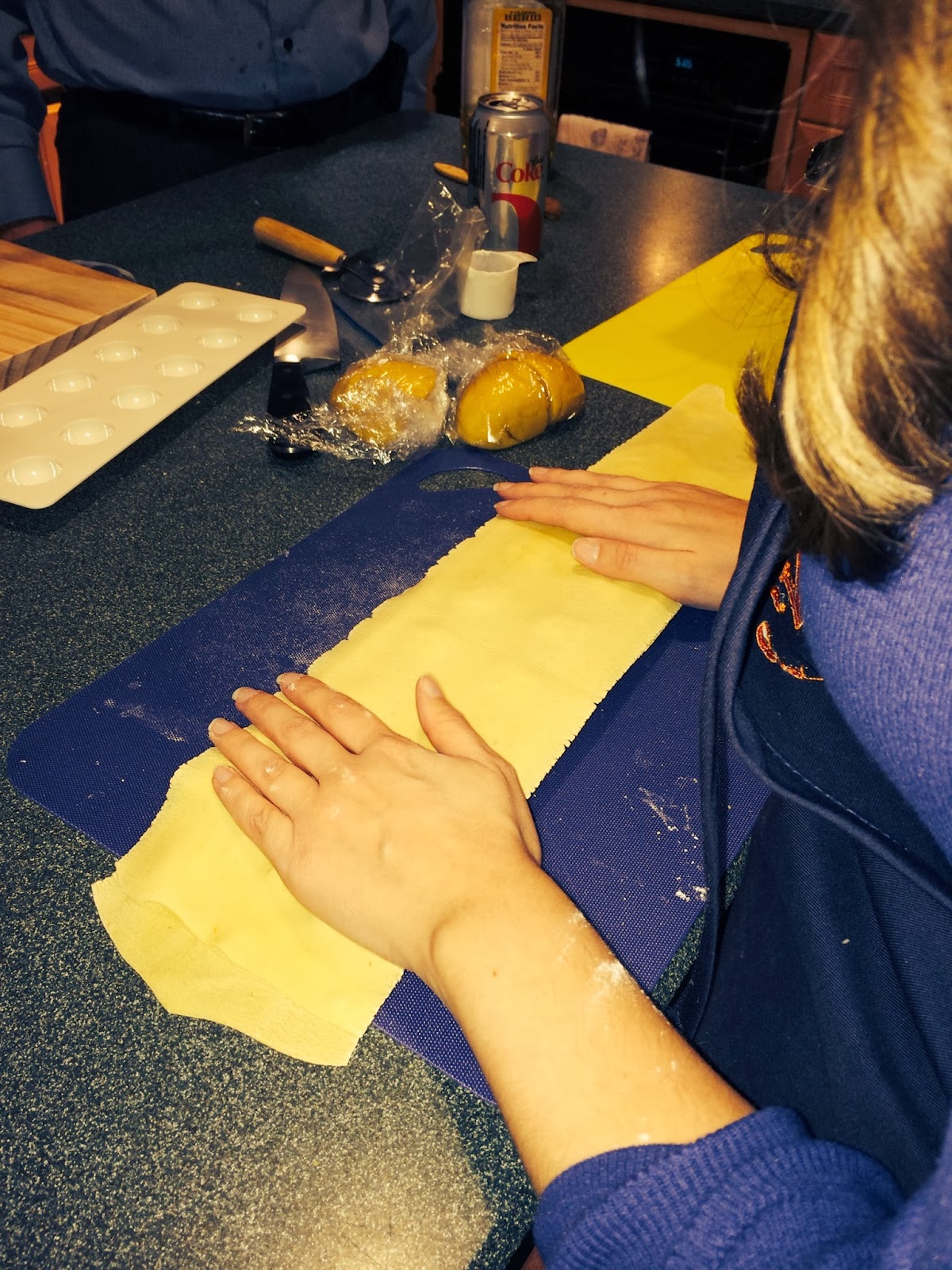
3) Then we lay a sheet of dough over the floured ravioli tray:


4) Then take a teaspoon of filling and place in each indentation. (Be careful not to overfill! I was guilty of this. It will make your ravioli explode in the pot.) I made the "four cheese" filling from a mixture of ricotta, shredded mozzarella, asiago, and parmesan, seasoned with black pepper and chopped fresh parsley:


5) Then lay a second sheet of dough over the top and press down the sides gently:


6) Then carefully flip your ravioli out of the tray onto a floured sheet pan covered in parchment paper:


and separate the ravioli along the serrated edges:


7) Next drop the ravioli into a pot of salted boiling water:


the ravioli will float to the surface when ready, only a minute or two of cooking. Ladle out of the pot and toss with sauce of choice. We made a saffron-infused champagne cream sauce.

We served the ravioli with seared scallops and roasted asparagus:


It was a decadent, elegant, and delicious New Year's Eve Meal!